Overview of Currency in Laos and Where to Exchange Money Safely (best places to exchange kip, USD to LAK rates, airport vs city tips)
- Overview of Currency in Laos and Where to Exchange Money Safely (best places to exchange kip, USD to LAK rates, airport vs city tips)
Welcome to Laos! While this Southeast Asian gem moves at a famously relaxed pace, its financial systems require a bit of planning. Unlike some neighboring countries where the US Dollar (USD) dominates, Laos operates primarily on its own currency, the Lao Kip (LAK). However, USD and Thai Baht (THB) remain highly relevant, especially for larger purchases or in major hubs. Understanding the dynamics between these currencies is the key to budgeting effectively and avoiding unnecessary fees during your travels. Our aim is to equip you with the expert knowledge needed to handle your money safely and efficiently, ensuring you always get the best value when you exchange your foreign cash.
Understanding the Lao Currency: The Kip (LAK)
The official currency of the Lao People’s Democratic Republic is the Lao Kip, denoted universally as LAK. Introduced in 1952, the Kip has experienced significant inflation over the decades, meaning you will frequently deal with large denominations. It is essential to note that the Kip is not traded internationally; you cannot buy it outside of Laos. Therefore, all currency exchange must happen once you arrive.
Denominations and Practical Use
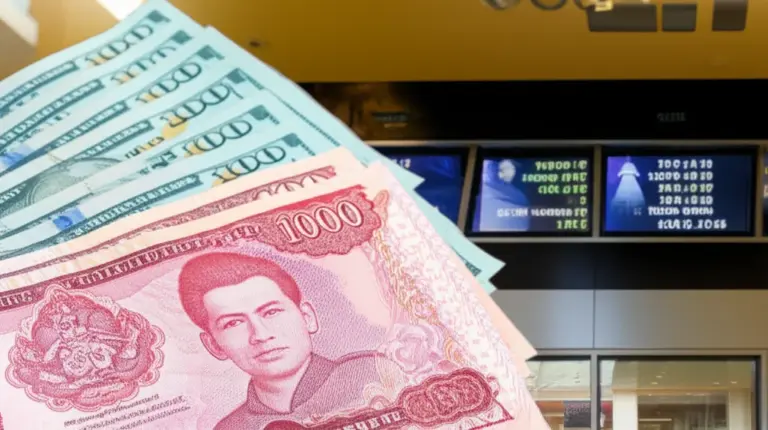
Lao Kip banknotes come in denominations ranging from 1,000 LAK up to 100,000 LAK. You will rarely see coins in circulation. For daily expenses—like street food, local transport (tuk-tuks), or small market purchases—you will typically use notes between 5,000 LAK and 20,000 LAK. It is wise to always carry smaller bills, as vendors often struggle to break a 100,000 LAK note for a small purchase.
The USD/THB Influence
While LAK is required for local goods and services, Laos operates on a dual-currency system, especially in tourist areas and large cities like Vientiane and Luang Prabang. Large transactions, such as paying for hotels or organized tours, are often quoted and accepted in USD or Thai Baht (THB). If you pay in USD, you will almost always receive your change back in LAK. Always confirm which currency the vendor prefers before agreeing on a price.
The difference between a good exchange and a poor one can significantly impact your travel budget. Understanding how rates fluctuate is paramount when planning where to exchange your foreign currency.
The Official vs. Street Rate Myth
In many developing economies, there is a noticeable gap between the official bank rate and the informal ‘street’ rate. In Laos, this gap is generally minimal today, especially since the liberalization of banking. Stick to established, licensed exchange counters or banks; they usually offer rates very close to the actual market rate. Avoid unlicensed money changers operating from small, unmarked shops, as these carry the highest risk of error or fraud.
Real-Time USD to LAK Rate Tips
The exchange rate fluctuates daily based on global markets. Before you travel, check the current approximate rate online. For example, if the rate is around 17,500 LAK per 1 USD, any quote significantly below 17,400 LAK should be viewed with suspicion. Always look for rates posted digitally or on official signage.
Where to Exchange Money Safely in Laos
Choosing the right location is the single most important factor in securing a good deal and ensuring security. We break down the options below to help you determine the **best places to exchange kip** for your specific needs.
The Best Places to Exchange Kip: Banks and Licensed Bureaus
For maximum security and competitive rates, licensed money exchange bureaus (often branded as FOREX or specialized bureaus) and major commercial banks are your top choice. These establishments are regulated and transparent. In Vientiane and Luang Prabang, these are plentiful, especially near major markets or backpacker streets. Always ensure the counter displays official licensing information. These locations offer the most trustworthy exchange experience.
Airport Exchange Booths: Convenience vs. Cost
Upon landing at Wattay International Airport (VTE) in Vientiane or Luang Prabang International Airport (LPQ), you will find exchange counters immediately available. While convenient, airport rates are notoriously poor—often 5% to 10% worse than city rates. Our strong recommendation is to exchange only enough currency (e.g., $30–$50 USD) to cover your taxi, visa fee (if applicable), and initial water/snack purchase. Save the bulk of your exchange for the city.
City Centers: Vientiane, Luang Prabang, Vang Vieng
| Location | Exchange Tip | Security Level |
|---|---|---|
| Vientiane (Capital) | Highest competition means better rates. Look along Lane Xang Avenue. | High |
| Luang Prabang | Rates are generally good, slightly lower than Vientiane due to lower volume. | High |
| Northern/Rural Areas | USD/THB is often accepted directly. Exchange only what is necessary in advance. | Medium |
ATM Withdrawals: Convenience and Fees
For travelers who prefer not to carry large amounts of cash, ATMs are widely available in major cities and tourist towns. However, they come with fees. The Lao banking system relies heavily on international networks like Plus and Cirrus.
Which Cards Work Best?
Visa and Mastercard are the most commonly accepted cards at Lao ATMs. Always notify your home bank of your travel dates to prevent your card from being flagged for fraud. Be aware that many Lao banks impose a fixed withdrawal fee per transaction, which can add up quickly. For example, a 25,000 LAK fee on a small withdrawal can drastically increase your overall cost.
Local Withdrawal Limits
Lao ATMs typically have low per-transaction limits, often capped around 2,000,000 LAK or 3,000,000 LAK. This means if you need a larger sum, you may have to perform multiple transactions, incurring multiple fixed fees. For large cash needs, exchanging physical USD at a bank remains the most cost-effective method.
Essential Money Safety Tips for Tourists in Laos
Laos is generally a very safe country for tourists, but standard precautions apply, especially concerning cash handling.
Watch Out for Exchange Tricks
When exchanging cash, particularly large US Dollar bills ($100s), be extremely vigilant. Scammers sometimes use sleight of hand to switch a high-value note for a lower one, or they may ‘accidentally’ miscount the LAK given back to you. Always count the LAK received immediately, preferably in front of the teller, before leaving the window. Do not let them rush you.
To give you a visual guide on navigating the streets and handling cash, here is a helpful resource:
Finally, remember that Laos is predominantly a cash-based economy. While credit cards are accepted at upscale restaurants and major hotels in Vientiane, they are almost useless outside these main tourist circuits. Budgeting in LAK and carrying sufficient physical cash (in small to medium denominations) will ensure you experience the country without constant financial stress. Always keep your primary stash of USD secure, perhaps in a money belt, and only carry enough LAK for the day’s activities.
คำถามที่พบบ่อย (FAQ)
While LAK is official, USD and Thai Baht (THB) are widely accepted for larger transactions, especially in tourist areas like Luang Prabang and Vang Vieng. For small, local purchases, LAK is mandatory.
Airport rates are usually the worst. Exchange only enough currency to cover immediate needs like airport transfer or visa fees (if paying in cash). Find a licensed bureau in the city center for better rates.
Be wary of fast-counting or ‘short-changing’ scams, especially at smaller, unofficial stalls. Always count your LAK carefully and deliberately before concluding the transaction, and avoid exchanging money in dark or isolated areas.
Expect a flat fee per transaction, often ranging from 20,000 to 30,000 LAK, levied by the local bank, in addition to any international fees charged by your home bank.
References
Bank of Lao PDR Official Site
International Monetary Fund (IMF) Country Data for Laos
- Money Matters in Laos: Complete Guide to ATMs, Exchange Rates, and Paying by Card
- Finding and Using ATMs in Laos: Fees, Limits, and Safety Tips (how to locate ATMs, withdrawal fees, daily limits, card compatibility)
- Understanding Exchange Rates and How to Get the Best Rate (spot vs tourist rates, using apps, avoiding hidden commissions)