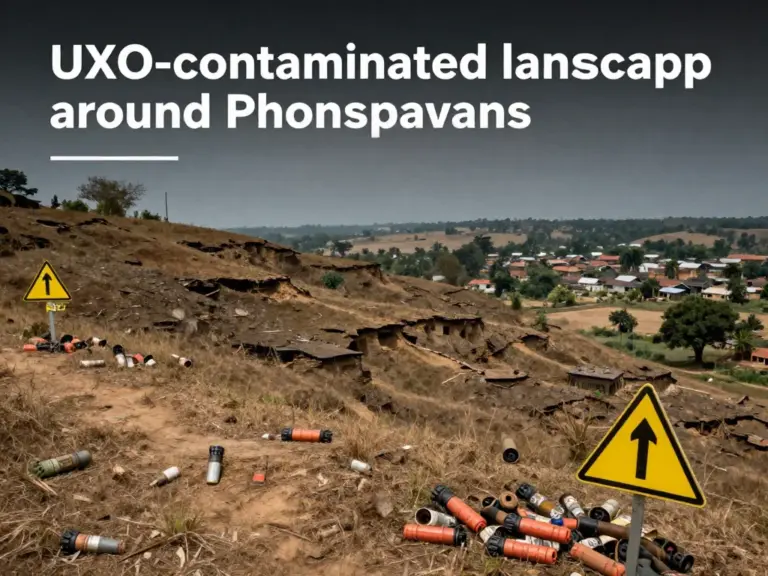
What is UXO and why Phonsavan is the epicenter of Laos’ post-war landscape
To understand the modern identity of Laos, one must look beneath the surface—quite literally. For many travelers engaged in Laos Tourism, the town of Phonsavan in Xieng Khouang province serves as a gateway to the mysterious Plain of Jars. However, it also serves as a sobering classroom for understanding What is UXO and why this region remains the most heavily bombed place on earth per capita.
Defining the Legacy: What is UXO?
UXO, or Unexploded Ordnance, refers to bombs, shells, grenades, and landmines that were fired or dropped but failed to explode upon impact. In Laos, the majority of UXO consists of ‘bombies’—small submunitions from cluster bombs. During the ‘Secret War’ (1964–1973), over 270 million cluster munitions were dropped on Laos. It is estimated that up to 30% of these failed to detonate, leaving approximately 80 million live ‘bombies’ scattered across the countryside.
Phonsavan: The Epicenter of the Post-War Landscape
Phonsavan was rebuilt after being almost entirely leveled during the conflict. Today, it stands as the epicenter of Laos’ recovery efforts. The surrounding Xieng Khouang province was a strategic focal point due to its location near the Ho Chi Minh Trail and the presence of the communist Pathet Lao headquarters. Consequently, the density of UXO here is higher than anywhere else in the country.
The Visual Reality of Phonsavan
Walking through Phonsavan, the legacy of the war is impossible to miss. Local architecture and decor often incorporate ‘war scrap.’ You will find:
- Bomb casings used as fence posts and pillars.
- Scrap metal fashioned into spoons and jewelry.
- Large fuel tanks repurposed as water storage or boats.
Impact on Tourism and Local Life
For the people of Xieng Khouang, UXO is not just a historical footnote; it is a daily hazard. Farmers risk their lives tilling the soil, and children often mistake the ball-shaped bombies for toys. Organizations like the UXO Visitor Center and MAG (Mines Advisory Group) in Phonsavan work tirelessly to clear land and provide victim assistance. For tourists, visiting these centers is an essential part of the journey, providing context to the resilience of the Lao people.
Visiting Safely: What Travelers Need to Know
While Phonsavan is safe for tourists who stick to marked paths, it is vital to respect the warning signs. The ‘White and Red’ markers indicate cleared and uncleared zones. When visiting the Plain of Jars, always stay within the designated areas cleared by MAG.
คำถามที่พบบ่อย (FAQ)
What does UXO stand for?
Why is Phonsavan so heavily affected by UXO?
Is it safe to visit Phonsavan?
What can tourists do to help?
References
- UXO History in Phonsavan: Visiting the MAG Center and Beyond — A Traveler’s Guide to Laos’ War Legacy and Safety Initiatives
- How to visit the MAG (Mines Advisory Group) Visitor Centre: hours, exhibits, and guided tour expectations
- Exploring surrounding sites and community projects: UXO clearance villages, memorials, and cultural experiences