Getting Around Laos: The Ultimate Guide to Transportation Options for Travelers
Laos, the land of a million elephants, is a country of rugged mountains, Mekong River vistas, and a pace of life that invites you to slow down. Historically, Getting Around Laos was known to be a test of patience, involving long journeys on winding mountain roads. However, with recent infrastructure developments—most notably the Laos-China Railway—traveling through this beautiful nation has been transformed. Whether you are looking for the speed of a modern train or the nostalgic drift of a slow boat, this guide covers everything you need to know for your next adventure in Laos Tourism.
1. The Laos-China Railway: A Game Changer
The introduction of the high-speed railway has revolutionized Getting Around Laos. Connecting Vientiane with the northern border, this train slashes travel times between major hubs like Vang Vieng and Luang Prabang from several hours to under an hour.
| Route | Old Bus Time | New Train Time |
|---|---|---|
| Vientiane to Vang Vieng | 3-4 Hours | ~50 Minutes |
| Vang Vieng to Luang Prabang | 4-6 Hours | ~50 Minutes |
| Vientiane to Luang Prabang | 8-10 Hours | ~2 Hours |
Tickets can be purchased via the ‘LCR Ticket’ mobile app or at the station. It is highly recommended to book at least 2-3 days in advance, as seats fill up quickly during peak tourism seasons.
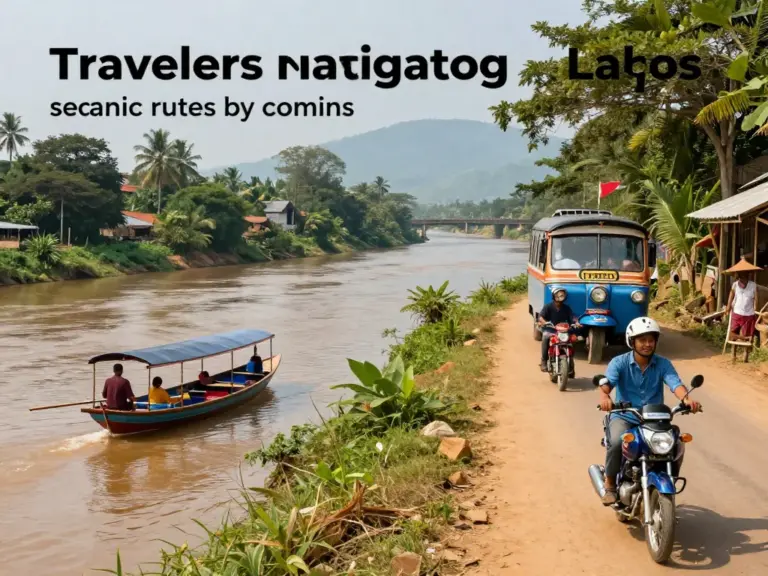
For many, the quintessential Laos experience is the two-day slow boat journey from Huay Xai (on the Thai border) to Luang Prabang. This journey offers unparalleled views of the Mekong River and rural Lao life. You will spend two days drifting downstream, with an overnight stop in the small village of Pakbeng. It is less about the destination and more about the serene experience of the landscape.
3. Buses, Minivans, and VIP Coaches
While the train covers the north-south spine, buses remain essential for reaching destinations like Phonsavan (Plain of Jars) or the southern islands of Si Phan Don (4,000 Islands). Minivans are the most common choice for shorter inter-city hops; they are faster but can be quite cramped. Sleeper buses are available for long-distance overnight travel, featuring lie-flat beds that are relatively comfortable for smaller travelers.
4. Local Transport: Tuk-Tuks and Songthaews
Within cities like Vientiane and Luang Prabang, the three-wheeled Tuk-Tuk is king. Always negotiate the fare before you start your journey. For a more modern experience, the Xanh SM or Loca ride-hailing apps are now widely used in Vientiane, offering fixed pricing and air-conditioned comfort.
5. Domestic Flights
If you are short on time, Lao Airlines and Lao Skyway operate domestic flights connecting Vientiane with Luang Prabang, Pakse, and Phonsavan. While more expensive than ground transport, a 45-minute flight can save you a full day of driving on mountainous roads.
คำถามที่พบบ่อย (FAQ)
Q: What is the best way to travel between Vientiane and Luang Prabang?
A: The high-speed Laos-China Railway is currently the fastest and most comfortable option, taking only about 2 hours.
Q: Is it easy to rent a motorbike in Laos?
A: Yes, motorbike rentals are common in tourist hubs like Thakhek (for ‘The Loop’) and Pakse. Ensure you have an International Driving Permit and proper insurance.
Q: Are there ride-hailing apps in Laos?
A: Yes, ‘Loca’ and ‘Xanh SM’ are popular ride-hailing services, primarily operating in Vientiane and Luang Prabang.
Q: How do I buy train tickets?
A: You can use the official LCR Ticket app or purchase them directly at the train station using a passport for identification.