Choosing Between Flights, Buses, and Trains: When to Fly vs. Overnight Bus vs. Slow Travel by Rail
Exploring the rugged landscapes of Laos is an adventure of a lifetime. From the misty mountains of the north to the tranquil islands of the south, the journey itself is often as memorable as the destination. However, when it comes to Choosing Between Flights, Buses, and Trains, the decision can significantly impact your budget, time, and overall experience. Laos has seen a transport revolution recently, particularly with the introduction of high-speed rail, making the logistics of travel more diverse than ever before.
The Speed of the Sky: When to Choose Flights
Flying is the ultimate time-saver in Laos. Historically, traveling from Vientiane to Pakse or Luang Prabang would take a full day on the road. With Lao Airlines or Lao Skyway, these journeys are reduced to under an hour. You should choose to fly if your itinerary is tight or if you want to avoid the physical toll of long-distance ground travel. Flying is particularly recommended for reaching the far south (Pakse) from Vientiane, as the rail network does not yet extend that far.
The Classic Backpacker Route: The Overnight Bus
The overnight ‘sleeper’ bus is a rite of passage for many visiting Southeast Asia. In Laos, these buses feature small bunks instead of reclining seats. While they are the most budget-friendly option and save you the cost of a night’s accommodation, they are best suited for those who can sleep anywhere. The winding, mountainous roads can be bumpy, so if you suffer from motion sickness, this might not be the best choice. However, for reaching remote areas like Phonsavan or the far north where the train doesn’t stop, the bus remains king.
| Feature | Flight | Overnight Bus | Train (LCR) |
|---|---|---|---|
| Cost | High | Low | Moderate |
| Speed | Very Fast | Slow | Fast |
| Comfort | High | Variable | Very High |
The New Era: Slow Travel and High-Speed Rail
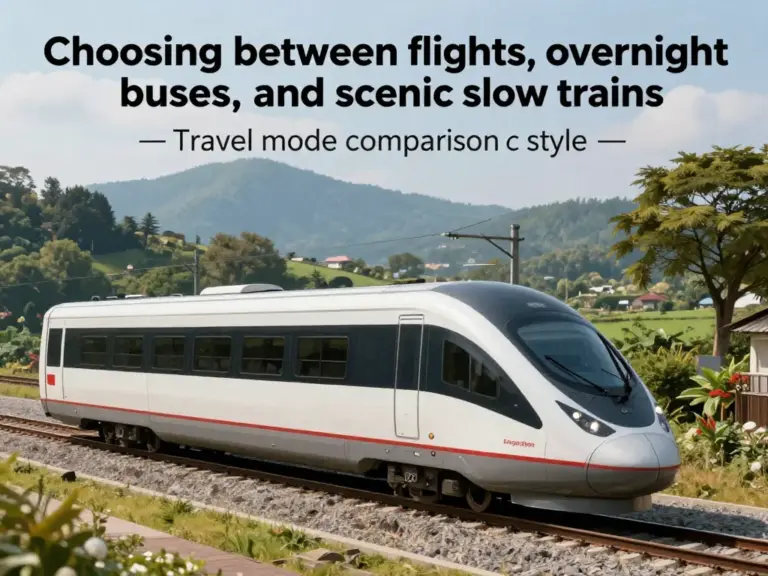
The Laos-China Railway (LCR) has transformed travel between Vientiane, Vang Vieng, Luang Prabang, and Muang Xai. It offers a ‘slow travel’ philosophy in terms of scenic enjoyment but with high-speed efficiency. Choosing the train is ideal for those who want to see the stunning karst scenery and lush valleys through large windows without the nausea of a winding bus ride. It is the perfect middle ground: faster than a bus, cheaper than a flight, and arguably the most comfortable way to move through the heart of the country.
Comparing the Logistics: Practical Considerations
When Choosing Between Flights, Buses, and Trains, consider the ‘hidden’ time. Airports and train stations in Laos are often located 20-30 minutes outside of the main town centers. For the train, you must arrive at least an hour early for security checks, similar to an airport. Buses, conversely, often depart from stations closer to town or include a guesthouse pickup, making them slightly more convenient for door-to-door transit despite the longer travel time.
คำถามที่พบบ่อย (FAQ)
Q: Is it easy to buy train tickets in Laos?
A: Tickets can be purchased at the station or via the LCR official app. It is recommended to book 2-3 days in advance as they often sell out.
Q: Are sleeper buses safe for solo female travelers?
A: Generally, yes. However, you often share a narrow bunk with another person. If traveling alone, you may want to book two spots or check if the bus has single-berth options.
Q: Which is the most eco-friendly option?
A: The train is the most sustainable way to travel long distances in Laos, followed by the bus. Flights have the highest carbon footprint per passenger.