What currency does Laos use, how to read Lao kip banknotes and coins, and current exchange rates for travelers
- What currency does Laos use, how to read Lao kip banknotes and coins, and current exchange rates for travelers
Welcome to Laos, the land of a million elephants! As you prepare for your journey, understanding the local currency is perhaps the most crucial step for a smooth and stress-free trip. The official currency of the Lao People’s Democratic Republic is the Lao Kip (LAK). Unlike many regional currencies, the Lao Kip is non-convertible outside of Laos, meaning you must obtain it upon arrival and spend it before you leave. This guide provides essential information on reading the banknotes, navigating exchange rates, and managing your money effectively while traveling in Laos.
Key Takeaway for Travelers
The official currency is the Lao Kip (LAK). While Thai Baht (THB) and US Dollars (USD) are sometimes accepted in major tourist areas, all daily transactions, especially in local markets and smaller towns, require the Lao Kip. Always carry small denominations of the Lao Kip.
The Official Currency of Laos: The Lao Kip (LAK)
The Lao Kip, officially abbreviated as LAK, is issued by the Bank of the Lao P.D.R. Due to its historically low value relative to major world currencies, you will quickly become accustomed to dealing with large denominations and numerous zeros. This can sometimes lead to confusion, particularly when handling thousands versus tens of thousands of Kip, so careful counting is essential.
Understanding the Lao Kip (LAK) System
The Kip is technically subdivided into 100 Att, but due to inflation and low value, Att coins are completely obsolete and are not used in modern transactions. All prices are rounded up or down to the nearest 100 or 500 Kip. The current series of banknotes features important national symbols and figures, most notably Kaysone Phomvihane, a former President and key revolutionary leader, who appears on many of the higher-value notes.
Is the Lao Kip Convertible?
No. The Lao Kip is a non-convertible currency, meaning it cannot be legally exchanged outside of Laos. This is a critical point for travelers. You should plan to convert only the amount you expect to spend and convert any remaining Kip back to a major currency (USD or THB) before crossing the border or flying out. Exchange facilities are usually available at international airports like Vientiane’s Wattay International Airport (VTE) and Luang Prabang International Airport (LPQ).
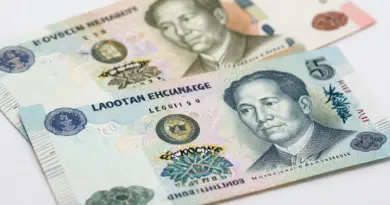
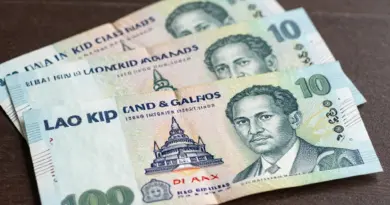
The most common banknotes you will encounter are 1,000, 2,000, 5,000, 10,000, 20,000, 50,000, and 100,000 Kip. Understanding the color and size differences is key to avoiding mispayments, especially in dimly lit markets.
Common Banknotes in Circulation
| Denomination (LAK) | Approximate Value (USD) | Key Features & Color |
|---|---|---|
| 1,000 Kip | Very Low | Smallest commonly used note. Green/Brown. |
| 5,000 Kip | Low | Light Brown/Orange. Important for small purchases. |
| 10,000 Kip | Moderate | Dark Blue/Purple. Often used for meals or transport. |
| 20,000 Kip | Higher Moderate | Red/Pink. Common for mid-range expenses. |
| 50,000 Kip | High | Green/Dark Blue. Useful for hotel payments or large purchases. |
| 100,000 Kip | Highest | Purple/Violet. The largest note, often difficult to break in small shops. |
How to Read the Banknotes
The value of the note is written clearly in both Lao script and Arabic numerals. Since the numbers are large, the main challenge is differentiating between the denominations that look similar, specifically 5,000 and 50,000 Kip, or 10,000 and 100,000 Kip. Always look for the number of zeros. A good rule of thumb is to mentally cover the last three zeros and read the remaining number to quickly gauge its value in thousands.
- Tip: When receiving change, always count the notes immediately, especially when dealing with the high denominations.
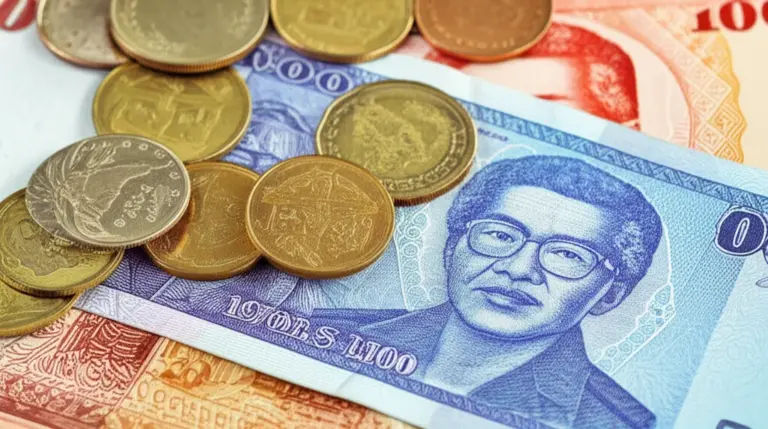
- Coins: While coins (10, 20, 50 Att) technically exist, they are not in circulation and hold no practical value for tourists or locals. Laos is effectively a coin-free economy.
Currency Exchange and Practical Tips for Travelers
Maximizing your spending power requires knowing the best places and ways to exchange your home currency. While the exchange rate fluctuates daily, staying informed is key.
Current Exchange Rates (Illustrative)
Rates are highly volatile, but generally, the Lao Kip maintains a high numerical value against major currencies. Always check a reliable source before exchanging, but here are general indicative rates (as of mid-2024):
- 1 USD ≈ 20,000 LAK
- 1 EUR ≈ 21,500 LAK
- 1 THB ≈ 550 LAK
Note: These rates are highly subject to change. Use official bank rates for accurate conversions.
Where to Exchange Currency in Laos
-
Currency Exchange Booths (Best Rates)
These are often found in city centers (Vientiane, Luang Prabang) and usually offer slightly better rates than banks or airports. Look for reputable, licensed exchange services.
-
Banks
Major banks like BCEL offer reliable, safe exchange services, though the process might be slower and the rates slightly less favorable than independent booths.
-
Airports and Hotels (Avoid if possible)
The exchange rates at Wattay Airport are notoriously poor. Only change a small amount here (enough for a taxi or initial expenses) and exchange the bulk of your money in the city.
Using Foreign Currency (USD and Thai Baht)
In Vientiane and the major tourist hubs of Luang Prabang and Vang Vieng, many hotels, restaurants, and tour operators readily accept US Dollars (USD) and Thai Baht (THB). However, the exchange rate they use internally is almost always rounded significantly in their favor. While convenient for large payments (like accommodation), you will save money by paying in Lao Kip for smaller items. For transactions in remote areas, only Kip will be accepted.
ATMs and Card Usage in Laos
ATMs are widely available in cities and major towns. However, be aware of two key limitations:
- Low Withdrawal Limits: Most ATMs limit withdrawals to 1,000,000 LAK to 2,000,000 LAK per transaction (approx. $50–$100 USD), which is very low given the high transaction fees.
- High Fees: Foreign card transactions usually incur a significant fee (often 20,000 LAK to 40,000 LAK) plus any fees charged by your home bank. Plan to make fewer, larger withdrawals if possible.
Credit card acceptance is limited almost exclusively to high-end hotels and large restaurants in Vientiane and Luang Prabang. Always carry sufficient cash (LAK) for daily expenses.
Budgeting and Cost of Living Snapshot
Laos is generally considered one of the more affordable destinations in Southeast Asia, though costs are rising, especially in popular areas. Knowing the rough costs in Lao Kip helps with budgeting:
Street Food Meal: 15,000 – 30,000 LAK
Local Beer (Large): 10,000 – 15,000 LAK
Guesthouse Room (Budget): 80,000 – 150,000 LAK
Short Tuk-Tuk Ride: 20,000 – 50,000 LAK (negotiate fiercely!)
By understanding the denominations and keeping track of the exchange rate, you can confidently manage your finances and fully enjoy the unique beauty and culture that Laos offers.
คำถามที่พบบ่อย (FAQ)
1. Can I use Thai Baht everywhere in Laos?
While Thai Baht (THB) is widely accepted in Vientiane and areas near the Thai border, and sometimes accepted by tourist-oriented businesses in Luang Prabang, it is not accepted everywhere. You will receive a much worse exchange rate if you pay in THB, and smaller, local businesses outside the main cities will require the Lao Kip (LAK).
2. Are there Lao Kip coins?
Historically, there were Kip coins (Att), but due to their extremely low value, they have been withdrawn from circulation. Laos operates entirely using banknotes, with the 1,000 Kip note being the smallest commonly used denomination.
3. Should I exchange money before arriving in Laos?
Since the Lao Kip is a non-convertible currency, you cannot legally obtain it outside of Laos. It is best to arrive with a major currency (USD or THB) and exchange it at a bank or exchange booth upon arrival in Vientiane or Luang Prabang for the best rates.
4. What is the largest Lao Kip banknote?
The largest banknote in general circulation is the 100,000 Lao Kip note. While useful for large payments, it can be difficult to break when making small purchases, so keep a stash of smaller 10,000 and 20,000 Kip notes handy.
References
Bank for Commerce and Industry (BCEL)
- Money in Laos: A Complete Guide to Lao Currency, Costs, and Practical Tips for Travelers and Expats
- Where and how to exchange money in Laos safely — airports, banks, exchange bureaus, and tips to avoid scams
- Using cash, cards, and mobile payments in Laos: ATM availability, credit card acceptance, fees, and recommended travel cards