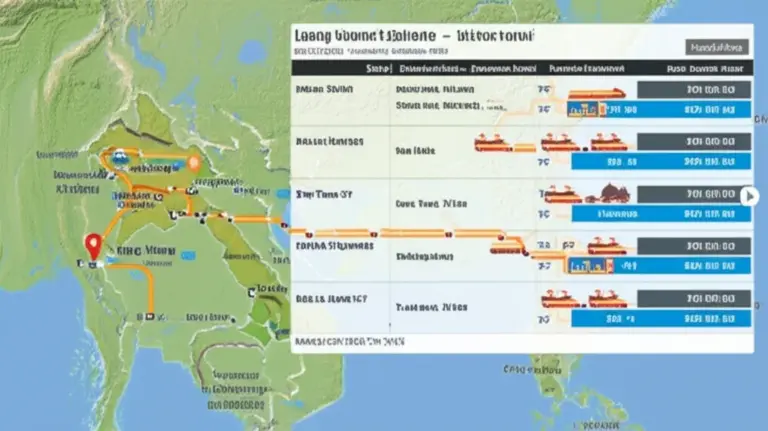
Day-by-day rail itinerary: detailed schedule, must-see attractions, transfers, and travel times for Luang Prabang, Vang Vieng, and Vientiane
- Day-by-day rail itinerary: detailed schedule, must-see attractions, transfers, and travel times for Luang Prabang, Vang Vieng, and Vientiane
The introduction of the Laos-China Railway (LCR) has fundamentally reshaped travel across Laos, transforming the previously arduous journey between its major tourist hubs—Luang Prabang, Vang Vieng, and Vientiane—into a seamless, high-speed experience. For those looking to explore the best of Laos efficiently and comfortably, planning a comprehensive Laos rail itinerary is essential. This detailed guide provides a day-by-day schedule, covering crucial travel times, station transfers, and the must-see attractions in each city, ensuring your Lao adventure is both authentic and hassle-free.
Trip Overview
This itinerary focuses on a 6-day journey, dedicating two full days to each city, maximizing cultural immersion while minimizing travel fatigue thanks to the efficiency of the high-speed rail network.
Route: Vientiane (Start/End Point) ↔ Vang Vieng ↔ Luang Prabang
The Rise of the Laos-China Railway: A Game Changer for Tourism
The Laos-China Railway, inaugurated in late 2021, is more than just infrastructure; it is a vital artery connecting the country’s north and south. What once took 6 to 10 hours by winding mountain bus now takes less than two hours by modern, air-conditioned train. This efficiency is crucial for maximizing sightseeing time and improving the overall quality of tourism in Laos.
Understanding the High-Speed Line
The railway primarily runs the high-speed ‘C’ trains and slower ‘K’ trains. For tourists following this Laos rail itinerary, the high-speed options are highly recommended for comfort and speed. Stations, however, are often located several kilometers outside the city centers, necessitating planning for transfers.
| Route | Approximate Travel Time (High-Speed) | Estimated Cost (Second Class) |
|---|---|---|
| Vientiane to Vang Vieng | 1 hour | $10 – $15 USD |
| Vang Vieng to Luang Prabang | 1 hour 15 minutes | $15 – $20 USD |
| Vientiane to Luang Prabang (Direct) | 1 hour 50 minutes | $25 – $35 USD |
The Ultimate 6-Day Laos Rail Itinerary
This schedule assumes starting the journey in Vientiane and traveling north, but the route can easily be reversed.
Days 1-2: Majestic Luang Prabang (Culture & History)
Luang Prabang, a UNESCO World Heritage site, is the spiritual heart of Laos. It is crucial to dedicate ample time here.
The Luang Prabang station (Luang Prabang Railway Station) is located about 15km north of the city center. Upon arrival, shared minivans or private taxis are the standard transfer options. Expect the transfer time to be 30–45 minutes.
- Day 1 Focus: Culture & History: Start the day by witnessing the Morning Alms Giving Ceremony, followed by exploring the Royal Palace Museum and the stunning temples of Wat Xieng Thong. End the day climbing Mount Phousi for a spectacular sunset view over the Mekong and Khan rivers.
- Day 2 Focus: Nature & Waterfalls: Dedicate this day to the iconic Kuang Si Falls. The three-tiered turquoise pools are perfect for swimming and relaxation. Consider visiting the nearby Bear Rescue Centre. Return in the evening to enjoy the vibrant Luang Prabang Night Market.
Day 3-4: Adventure in Vang Vieng (Nature & Thrills)
Vang Vieng is the adventure capital, nestled amidst dramatic karst mountains. The short train journey from Luang Prabang allows for almost a full day of activity upon arrival.
Travel Time: ~1 hour 15 minutes. Aim for a mid-morning departure (e.g., 10:30 AM) to arrive in Vang Vieng before lunchtime. The Vang Vieng station is also outside the town (around 5km), requiring a 15-minute minivan transfer.
- Day 3 Focus: Arrival & Exploration: Arrive, check into your accommodation, and immediately head out. Visit the famed Blue Lagoon (there are several; Lagoon 1 is the most popular). In the late afternoon, rent a bicycle or scooter to explore the surrounding rice paddies.
- Day 4 Focus: Views & Caves: Start early with a hike up Pha Ngern Viewpoint for breathtaking panoramic views of the karst landscape. After descending, explore the Tham Chang Cave or try river tubing on the Nam Song River for a classic Vang Vieng experience.
Day 5-6: Capital Charm in Vientiane (Modernity & Temples)
Vientiane, the laid-back capital, offers a mix of French colonial architecture, important Buddhist sites, and modern city life. It serves as the perfect conclusion to your Laos rail itinerary.
Travel Time: ~1 hour. The main hub is Vientiane Station (Vientiane Capital Station), located 15km north of the city. Allow 30-40 minutes for the final transfer into the city center (usually via shared taxi or minivan).
- Day 5 Focus: Iconic Landmarks: Take an early train from Vang Vieng. Upon arrival, visit Patuxai (the Victory Gate), often called the ‘Arc de Triomphe of Laos’. Then, explore the golden stupa of Pha That Luang, Laos’ most important national monument. Spend the evening strolling along the Mekong Riverside Park.
- Day 6 Focus: History & Departure: Visit the unique Buddha Park (Xieng Khuan), a sculpture park filled with Hindu and Buddhist statues, located about 25km outside the city. In the afternoon, explore Wat Si Saket (Vientiane’s oldest temple) and the Lao National Museum before heading to the airport or continuing your journey.
Practical Guide: Booking, Transfers, and Tips
Navigating the LCR requires specific knowledge regarding booking and local logistics, which differs significantly from previous travel methods.
Ticket Booking Strategies
- Advance Booking: Tickets sell out quickly, especially for weekend travel and public holidays. It is highly recommended to book at least 2-3 days in advance.
- Methods: Tourists generally rely on authorized travel agents, hotel booking services, or specialized online platforms, as the official Lao ticketing app requires a local bank account and phone number. Booking directly at the station is possible but means long queues and risk of sold-out trains.
- Documentation: You must present your original passport when booking and boarding the train. Digital copies are not accepted.
Station Logistics and Transfers
Due to the distance of the stations from the city centers, budgeting time and money for transfers is essential. Always arrive at the train station 60–90 minutes before departure for security checks and immigration procedures (if applicable). Shared minivans are the most cost-effective and common way to transfer between the city and the rail stations in all three locations.
Luggage and Comfort
The high-speed trains offer excellent comfort with spacious seating. However, luggage space is limited. There are restrictions on the size and weight of carry-on baggage (usually 20kg per person). Large backpacks and oversized suitcases may need to be stored in designated areas or might incur delays during security screening.
คำถามที่พบบ่อย (FAQ)
How far in advance should I book Laos train tickets?
It is strongly recommended to book high-speed train tickets at least 2 to 3 days in advance, especially if traveling during peak season, weekends, or public holidays. Tickets can sell out quickly, particularly the popular Luang Prabang to Vientiane route. Using a local travel agent is often the easiest way for foreigners to secure tickets.
What are the luggage restrictions on the Laos-China Railway?
Passengers are generally permitted to carry up to 20kg of luggage, with restrictions on dimensions (typically 130cm in length). Security checks are strict, and prohibited items include sharp objects, flammable materials, and certain liquids. If you are traveling with large bags, be prepared for thorough screening and limited space in the overhead racks.
Is it better to travel by train or bus between these cities?
For speed, comfort, and safety, the train is vastly superior for this Laos rail itinerary. While the bus is cheaper, the journey times are significantly longer (e.g., 6+ hours vs. 1.5 hours) and the mountain roads can be challenging. The high-speed rail saves valuable vacation time and provides a much more pleasant experience.
References
- 7-Day Laos Highlights by Rail: Ultimate Luang Prabang, Vang Vieng & Vientiane Itinerary for First-Time Travelers
- Best time to travel, rail routes, and how to plan a 7-day Laos trip by train from Luang Prabang to Vang Vieng and Vientiane
- Where to stay, eat, and book rail tickets: recommended hotels, guesthouses, local dishes, restaurants, and reliable train/ticket vendors