History and Significance of Wat Phu: Origins, Khmer Architecture, and UNESCO World Heritage Designation
- History and Significance of Wat Phu: Origins, Khmer Architecture, and UNESCO World Heritage Designation
- Discovering Wat Phu: A Gateway to Ancient Khmer Civilization
- The Deep Roots: Origins and the Era of Pre-Angkorian Kingdoms
- Architectural Majesty: Decoding Khmer Design at Wat Phu
- Global Recognition: Wat Phu UNESCO World Heritage Status
- Visiting Wat Phu: Essential Tips for Laos Tourism
- คำถามที่พบบ่อย (FAQ)
Discovering Wat Phu: A Gateway to Ancient Khmer Civilization
Wat Phu (Vat Phou) is not merely a collection of ruins; it is a meticulously planned religious landscape that predates the great temples of Angkor in Cambodia. Located near the Mekong River in Champasak Province, this site served as the primary religious center for the region from the 5th century until the 13th century, flourishing under the rule of the Chenla and subsequently the Khmer Empire. Its significance lies in its unique integration with the natural environment, particularly the sacred mountain, Phu Kao (Mount Lingaparvata).
The Deep Roots: Origins and the Era of Pre-Angkorian Kingdoms
The earliest evidence of worship at Wat Phu dates back to the 5th century, making it one of the oldest archaeological sites associated with the Khmer civilization. Before the rise of Angkor, the area was dominated by the Kingdom of Chenla, which viewed Wat Phu as its spiritual epicenter. The site was originally dedicated to the Hindu god Shiva.
Mount Lingaparvata and the Sacred Water Source
The entire complex is aligned along an axis leading directly to the base of Phu Kao, which translates to ‘Mountain of the Sacred Phallus’ or Lingaparvata. The mountain itself was revered as a natural representation of the Hindu Shiva Linga. Crucially, a natural spring flows from the mountain’s peak, directly behind the main sanctuary. This spring was channeled through the main temple, symbolizing the sacred union of Shiva and the life-giving waters, an architectural and religious feat of profound importance.
The journey up the mountain reflects a spiritual pilgrimage. Visitors ascend steep staircases, passing through six distinct terraces that represent different levels of spiritual attainment. The precision of the axial alignment is remarkable, demonstrating advanced understanding of engineering and cosmology by the ancient builders.
Architectural Majesty: Decoding Khmer Design at Wat Phu
While Wat Phu shares common elements with later Khmer architecture found at Angkor, its style is distinct, representing the transition from pre-Angkorian to classical Khmer periods. The layout is defined by a 1,400-meter-long axis stretching from the Mekong River bank up the hillside.
The Unique Terrace Layout and Axial Planning
The complex is divided into three main levels:
- Lower Level: Contains the two large rectangular Mandapas (palaces) and a series of barays (reservoirs) that managed water flow and irrigation. These structures were used for public ceremonies and royal residences.
- Middle Level: Features a long, steep pedestrian causeway connecting the lower and upper sections, flanked by decorative sandstone staircases and small pavilions.
- Upper Level: The most sacred area, housing the main sanctuary, which is built directly against the cliff face, maximizing its integration with the sacred mountain.
The construction materials evolved over time, starting with brick and later transitioning to durable sandstone, characteristic of the great Khmer building projects.
Iconic Sculptures and Bas-Reliefs
The stone carvings at Wat Phu are masterpieces of early Khmer art. Visitors can observe intricate bas-reliefs depicting Hindu mythology, including scenes from the Ramayana and representations of gods like Vishnu, Shiva, and Brahma. The iconic lintels, particularly those found on the Mandapas, showcase the distinct Pre-Angkorian style—characterized by dense, stylized foliage and mythical creatures—that laid the foundation for the more complex sculptures seen at Angkor Wat centuries later.
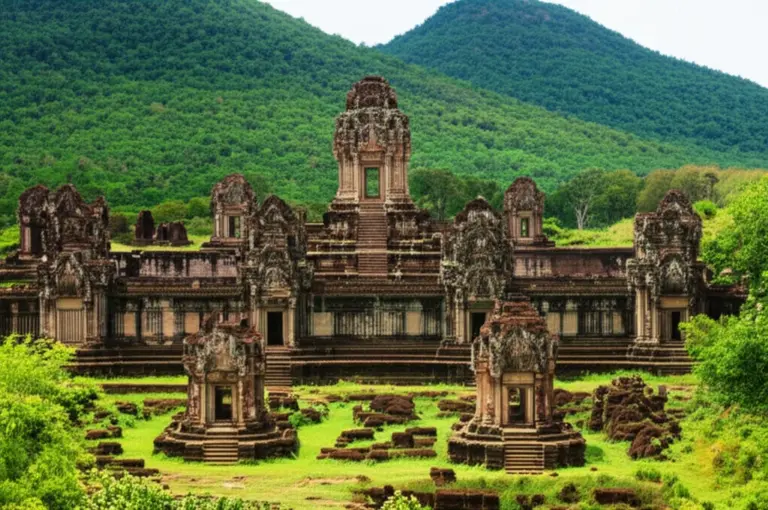
Experience the scale and beauty of this ancient sanctuary before your visit:
Global Recognition: Wat Phu UNESCO World Heritage Status
In 2001, the cultural landscape of Wat Phu and the surrounding ancient settlements of Champasak were officially inscribed on the UNESCO World Heritage List. This designation recognizes the site’s outstanding universal value, particularly its role as an exceptional example of the integration of a temple complex with the natural environment, expressing the Hindu vision of the relationship between man and nature.
Criteria for Designation and Protection Efforts
The **Wat Phu UNESCO World Heritage** designation was granted based on several key criteria, including:
- It represents a masterpiece of human creative genius (Criterion II).
- It exhibits an important interchange of human values over a span of time (Criterion III).
- It is an outstanding example of a traditional human settlement, land-use, or sea-use which is representative of a culture (Criterion IV).
Since gaining this status, substantial international efforts have been made, involving organizations like the French School of Asian Studies (EFEO), to conserve the fragile sandstone structures and manage the site responsibly for future generations of Laos tourism.
Visiting Wat Phu: Essential Tips for Laos Tourism
For visitors traveling to Southern Laos, Wat Phu is an undeniable highlight. The site is easily accessible from Pakse, the regional hub, via a short drive or ferry crossing over the Mekong to the town of Champasak. The best time to visit is during the dry season (November to March) when the weather is cooler. Remember that this is an active religious site, so modest dress is required, especially when climbing to the main sanctuary.