Who are Laos’ Hill Tribes? An Overview of Major Ethnic Groups, Languages, and Historic Roots
- Who are Laos’ Hill Tribes? An Overview of Major Ethnic Groups, Languages, and Historic Roots
Laos, the landlocked jewel of Southeast Asia, is often celebrated for its serene landscapes, ancient temples, and the gentle flow of the Mekong River. Yet, the true richness of the nation lies in its remarkable cultural diversity. A journey into the northern provinces reveals the vibrant tapestry woven by Laos’ Hill Tribes—highlander communities whose traditions, languages, and historic roots contrast sharply with those of the lowland Lao people. Understanding these groups is essential for anyone interested in Laos tourism, offering a profound appreciation for the country’s anthropological heritage.
Defining Laos’ Ethnic Landscape: More Than Just ‘Hill Tribes’
While the majority of the population belongs to the Lao Loum (Lowland Lao), the remainder—collectively referred to as the Lao Theung (Midland Lao) and Lao Soung (Highland Lao)—constitutes the diverse ethnic minority groups. These communities generally inhabit the mountainous terrain, maintaining distinct agricultural practices, often centered around shifting cultivation (swidden farming), though modern governmental efforts have encouraged sedentary lifestyles.
The Four Ethnolinguistic Families
Anthropologists classify the numerous ethnic groups of Laos into four primary linguistic families, which helps trace their historic roots and migration patterns across the region. These families define the fundamental differences in language structure and traditional homeland:
| Family | Description | Major Representative Groups |
|---|---|---|
| Tai-Kadai | Includes the Lao Loum, Tai Dam, and Tai Lue. These groups generally inhabit river valleys and lowlands. | Lao, Tai Dam, Tai Lue |
| Austroasiatic (Mon-Khmer) | Considered the earliest inhabitants of mainland Southeast Asia, often referred to as Lao Theung (Midland Lao). | Khmu, Katang, Alak |
| Hmong-Mien (Miao-Yao) | Relatively recent migrants (19th century) from Southern China, typically residing in the highest elevations (Lao Soung). | Hmong, Mien (Yao) |
| Sino-Tibetan | Groups with origins tracing back to Tibet and Southwest China. | Akha, Lahu, Phunoi |
Major Ethnic Groups and Their Cultural Heritage
Among the most prominent and frequently encountered of Laos’ Hill Tribes are the Khmu, Hmong, and Akha. Each group maintains a fiercely independent cultural identity, visible in their architecture, clothing, and spiritual practices.
The Resilient Khmu (Austroasiatic)
The Khmu are one of the largest minority groups in Northern Laos, particularly prevalent around Luang Prabang and Oudomxay. As part of the Austroasiatic family, they are considered the indigenous inhabitants of much of the northern mountains. Khmu society is traditionally animistic, centered on the worship of spirits (phi) associated with nature, ancestors, and the household. They are renowned for their intricate basket weaving and knowledge of forest resources.
The Independent Hmong (Hmong-Mien)
The Hmong are perhaps the most globally recognized of Laos’ Hill Tribes, largely due to their complex history tied to the Indochina Wars. They are highly skilled agriculturalists, traditionally cultivating rice, corn, and opium (historically). Their vibrant textiles, particularly the intricate reverse appliqué work known as paj ntaub, are internationally celebrated. The Hmong New Year (Nkauj Hmoob Xyoo Tshiab) is a crucial cultural festival, marked by elaborate dress, feasting, and traditional ball tossing.
The Colorful Akha (Sino-Tibetan)
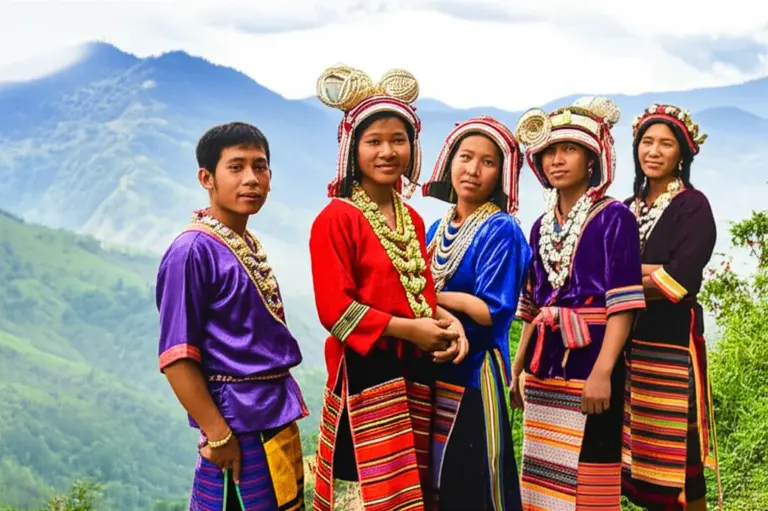
The Akha, found primarily in the far north (Phongsali and Luang Namtha), are instantly recognizable by the elaborate, silver-studded headdresses worn by their women. These headdresses are complex artifacts that reflect the wearer’s age, marital status, and social standing. Akha villages are often guarded by a distinctive ‘spirit gate’ which marks the boundary between the human and spirit worlds. Their deeply held animistic beliefs govern daily life, including the maintenance of the ‘Akha Way’ (customary law).
Languages, Traditions, and Historic Migration Routes
The linguistic diversity among Laos’ Hill Tribes is staggering. Many languages within the Austroasiatic and Hmong-Mien families remained purely oral until recent efforts by linguists to create written scripts. This reliance on oral tradition means that history, folklore, and medicinal knowledge are transmitted directly through generations via songs, rituals, and storytelling.
The majority of the highland groups migrated into Laos relatively recently. The Hmong and Mien entered from Southern China starting in the 18th century, seeking fertile land and fleeing conflict. Their historic migration routes crisscrossed mountainous regions, leading to cultural connections with similar groups in Vietnam, Thailand, and Myanmar. Conversely, the Khmu and other Mon-Khmer groups have been settled in the region for millennia, making them crucial components of the region’s deep history.
Watch a brief overview of the cultural practices of Laos’ diverse ethnic groups:
Hill Tribes in Modern Laos and Ethical Tourism
Today, many members of Laos’ Hill Tribes are integrating into the national economy, often through tourism and agriculture. However, they continue to face challenges related to development, infrastructure, and the preservation of their distinct languages and customs. For the responsible tourist, interactions with these communities offer unparalleled cultural insight, but respect is paramount.
Ethical Tourism Tips: Always ask permission before taking photographs of people, especially elders or children. Purchase handicrafts directly from the villages to ensure economic benefits reach the community. Dress modestly when visiting villages, and avoid touching the sacred ‘spirit gates’ if visiting Akha communities.
Exploring the cultural heritage of these highlander communities—from the shamanic rituals of the Hmong to the communal longhouses of the Khmu—provides the deepest and most rewarding experience of Laos. By engaging ethically and learning about their historic roots, travelers contribute positively to the preservation of these unique cultures.
คำถามที่พบบ่อย (FAQ)
References
- Lao National Tourism Administration: Ethnic Groups Overview
- Anthropological Studies of the Khmu People
- Hmong Cultural Center Resources
- Exploring Laos’ Ethnic Diversity: A Traveler’s Guide to the Country’s Hill Tribes and Cultural Encounters
- Where to Visit: Best Hill Tribe Villages and Regions in Laos for Authentic Cultural Experiences
- How to Travel Responsibly: Ethical Tourism, Cultural Sensitivity, and Supporting Local Communities