Where is the Bolaven Plateau and why is it the best region in Laos for waterfall exploration? (location, climate, and accessibility)
- Where is the Bolaven Plateau and why is it the best region in Laos for waterfall exploration? (location, climate, and accessibility)
For the dedicated traveler seeking nature’s most dramatic displays, the Bolaven Plateau in Southern Laos is not just a destination; it’s a pilgrimage. Often overshadowed by the Mekong’s slow pace or the ancient temples of Luang Prabang, this highland region holds the undisputed title for the country’s most spectacular and accessible water features. The sheer volume and power of the cascades here make it the premier location for exploring the natural wonders of Laos. The quest to discover the region’s secrets begins with understanding its unique geography, the perfect climate that feeds its rivers, and the easy accessibility that makes exploring the many magnificent Bolaven Plateau waterfalls an unforgettable adventure.
The Geographical Heart of Southern Laos: Bolaven Plateau Location
The Bolaven Plateau is an elevated region situated in Southern Laos. While most of the plateau is concentrated within the Champasak Province, its edges extend into the neighboring provinces of Salavan, Sekong, and Attapeu. Geographically, it is a vast, fertile highland bordered by the Annamite Range to the east—the natural boundary with Vietnam—and the mighty Mekong River to the west. This strategic location dictates its unique geological and climatic features. The name ‘Bolaven’ itself is derived from the Laven ethnic group who historically dominated the region. [[1]](https://www.asiatouradvisor.com/bolaven-plateau-tad-fane-waterfall-champsak/)[[2]](https://khiri.com/experience-the-best-of-the-bolaven-plateau-laos/)
Elevation and The Volcanic Legacy
The plateau’s elevation ranges significantly, typically from 1,000 to 1,350 meters (3,280 to 4,430 feet) above sea level. This high altitude is a direct result of ancient volcanic activity, which left behind a foundation of rich, red basaltic soil. This soil is incredibly fertile, making the region a powerhouse for agriculture, particularly for growing world-class Arabica and Robusta coffee. Critically, this elevation is the key ingredient for the waterfalls: it creates the steep drops and gorges necessary for massive rivers to cascade dramatically. [[1]](https://www.asiatouradvisor.com/bolaven-plateau-tad-fane-waterfall-champsak/)[[2]](https://khiri.com/experience-the-best-of-the-bolaven-plateau-laos/)
Gateway City: Pakse
The main hub and starting point for any exploration of the Bolaven Plateau is Pakse, the capital of Champasak Province. Pakse offers the best infrastructure for tourists, including accommodation, motorbike rentals, organized tour operators, and major transport links (bus station, airport). From Pakse, the plateau’s waterfalls and coffee heartland are easily reached, making the town the essential gateway. [[1]](https://www.asiatouradvisor.com/bolaven-plateau-tad-fane-waterfall-champsak/)[[3]](https://discoverlaos.today/kr/post/bolaven-plateau-coffee-waterfalls-and-ethnic-villages)
The Perfect Climate for Waterfalls
One of the most compelling reasons the Bolaven Plateau is the best region for waterfall exploration is its unique microclimate. While the lowlands of Laos often experience sweltering heat, the plateau’s altitude provides a refreshing escape. The weather here is significantly cooler and milder, often requiring a light jacket or fleece in the evenings, particularly in the higher elevations near Paksong. [[1]](https://www.asiatouradvisor.com/bolaven-plateau-tad-fane-waterfall-champsak/)[[4]](https://www.golaos.tours/bolaven-plateau-known-for-its-coffee-plantations-waterfalls-and-cool-climate/)
The Advantage of Abundant Rainfall
The plateau receives substantial rainfall, which is vital for the coffee plantations and, more importantly, for sustaining the powerful waterfalls year-round. The best time to witness the cascades at their most magnificent is during and immediately after the rainy season, which typically runs from May to October. During this period, the rivers are swollen, and waterfalls like Tad Fane and Tad Yuang thunder down with incredible force, creating a truly awe-inspiring spectacle. Even in the dry season, the elevation and consistent rainfall keep the waterfalls flowing much more impressively than in other parts of Laos. [[1]](https://www.asiatouradvisor.com/bolaven-plateau-tad-fane-waterfall-champsak/)
Unmatched Accessibility: The Bolaven Plateau Loop
Accessibility is another crucial factor that elevates the Bolaven Plateau above other remote Laotian regions. The area is circled by a well-established route known as the **Bolaven Plateau Loop** (or Pakse Loop). This route is perfectly designed for independent travel and serves as an efficient way to visit the majority of the major waterfalls, coffee plantations, and ethnic villages. [[5]](https://www.youtube.com/watch?v=q2Q5eBuzgjY)[[6]](https://www.youtube.com/watch?v=GqULdxhXQHU)
Options for the Independent Explorer
The most popular method of traversing the Loop is by renting a semi-automatic motorbike from Pakse. However, for those uncomfortable on two wheels, the route is also easily covered by hiring a car with a driver, joining an organized tour, or utilizing local public transport that runs between the main towns like Paksong and Tad Lo. The well-maintained road system makes the Bolaven Plateau waterfalls a highly accessible adventure. [[3]](https://discoverlaos.today/kr/post/bolaven-plateau-coffee-waterfalls-and-ethnic-villages)[[6]](https://www.youtube.com/watch?v=GqULdxhXQHU)
The Star Attractions: Spectacular Waterfalls
The sheer concentration and variety of waterfalls solidify the plateau’s reputation. Within a short distance, travelers can encounter everything from gentle, multi-tiered cascades perfect for swimming to towering, monumental plunges that defy description. This density is simply unmatched in Laos.
Tad Fane: The Majestic Twins
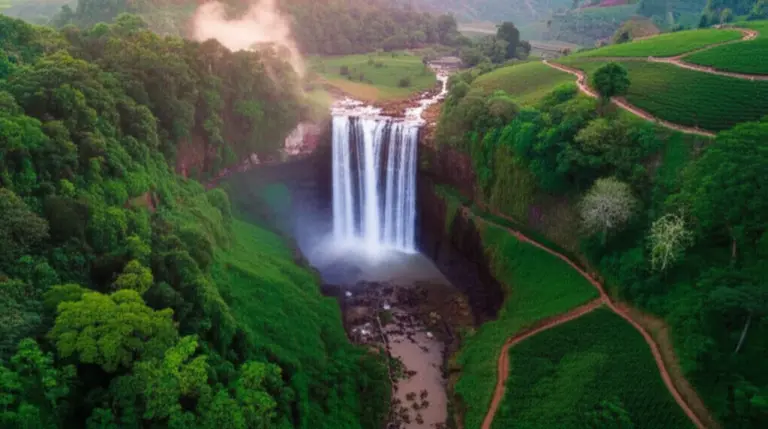
Tad Fane is arguably the most iconic waterfall in Laos. It consists of two massive columns of water plunging approximately 120 meters (394 feet) into a deep gorge, making it the tallest waterfall in the country. Located near Paksong, the view from the opposite cliff face is breathtaking and offers a true sense of the plateau’s dramatic landscape. [[1]](https://www.asiatouradvisor.com/bolaven-plateau-tad-fane-waterfall-champsak/)[[7]](https://en.wikipedia.org/wiki/Bolaven_Plateau)
Tad Yuang: Power and Beauty
Tad Yuang is known for its perfect, powerful curtain of water that drops into a large, swimmable pool. It is highly accessible and offers multiple viewpoints, making it one of the most photogenic and popular stops on the Loop. Its proximity to Tad Fane allows for an efficient day of exploration.
Tad Lo: The Relaxing Retreat
Tad Lo is a village built around a series of cascades, offering a more relaxed atmosphere. The waterfall itself is a pleasant, multi-tiered feature with surrounding guesthouses. It’s an ideal spot to spend a night and experience the quieter, local side of the plateau. [[5]](https://www.youtube.com/watch?v=q2Q5eBuzgjY)[[8]](https://www.youtube.com/watch?v=Fx9_KDHvi30)
Beyond the Waterfalls: Coffee, Culture, and E-E-A-T
While the waterfalls are the main draw, the Bolaven Plateau offers a rich cultural and agricultural experience that enhances its appeal. The cool climate and volcanic soil make it the premier coffee-growing region in Laos, accounting for nearly all of the country’s coffee production. Visitors can tour working coffee plantations, learn about the process from bean to cup, and sample some of the world’s finest brews. This agricultural expertise contributes significantly to the region’s overall character and visitor experience. [[4]](https://www.golaos.tours/bolaven-plateau-known-for-its-coffee-plantations-waterfalls-and-cool-climate/)[[6]](https://www.youtube.com/watch?v=GqULdxhXQHU)
Furthermore, the plateau is home to numerous ethnic minority groups, including the Alak, Katu, and Suay. Visiting their villages offers a unique opportunity to experience authentic Laotian culture and traditions, providing a deeper, more meaningful travel experience beyond the natural sights. The combination of stunning natural beauty, high accessibility, and rich cultural heritage confirms the Bolaven Plateau’s status as the ultimate destination for waterfall and cultural exploration in Laos.
คำถามที่พบบ่อย (FAQ)
Is the Bolaven Plateau safe for solo travelers?
Yes, the Bolaven Plateau is generally considered very safe for solo travelers, including those doing the motorbike loop. The roads on the main loop are well-trafficked, and locals are accustomed to tourists. Standard safety precautions, especially regarding motorcycle riding and road conditions, should always be observed.
What is the best time of year to visit the Bolaven Plateau waterfalls?
The best time to visit is during the shoulder season (October to December), immediately following the peak rainy season. This ensures the waterfalls are at their fullest and most powerful, but the weather is starting to cool and the roads are drier. The rainy season (May-October) offers the most dramatic water flow but comes with challenging road conditions.
What is the nearest major town to the Bolaven Plateau?
The nearest major town is Pakse, located in Champasak Province. Pakse serves as the primary base for all Bolaven Plateau explorations, offering the best access, rental services, and transportation links for starting the famous Bolaven Loop.
Why is the Bolaven Plateau also famous for coffee?
The plateau’s high elevation (1,000-1,350m), cool climate, and rich, volcanic basaltic soil create ideal conditions for growing high-quality Arabica and Robusta coffee. This region is responsible for producing approximately 95% of Laos’ coffee, making coffee culture a central part of the visitor experience alongside the Bolaven Plateau waterfalls.
References
- Asia Tour Advisor: Bolaven Plateau & Tad Fane Waterfall
- Khiri Travel: Experience the Best of the Bolaven Plateau, Laos
- Wikipedia: Bolaven Plateau
- Go Laos Tours: Bolaven Plateau – Known For Its Coffee Plantations
- The Bolaven Plateau: The Ultimate Guide to Waterfalls, Best Routes, and Practical Travel Tips
- Top waterfalls on the Bolaven Plateau: descriptions, must-see highlights, and the best time to visit each (Tad Fane, Tad Yuang, Tad Lo, Tad Tung)
- Planning your route: suggested itineraries, transportation options, accommodation, and day-trip vs multi-day considerations